PTA Tax Rates 2026–27: Complete Table Explained
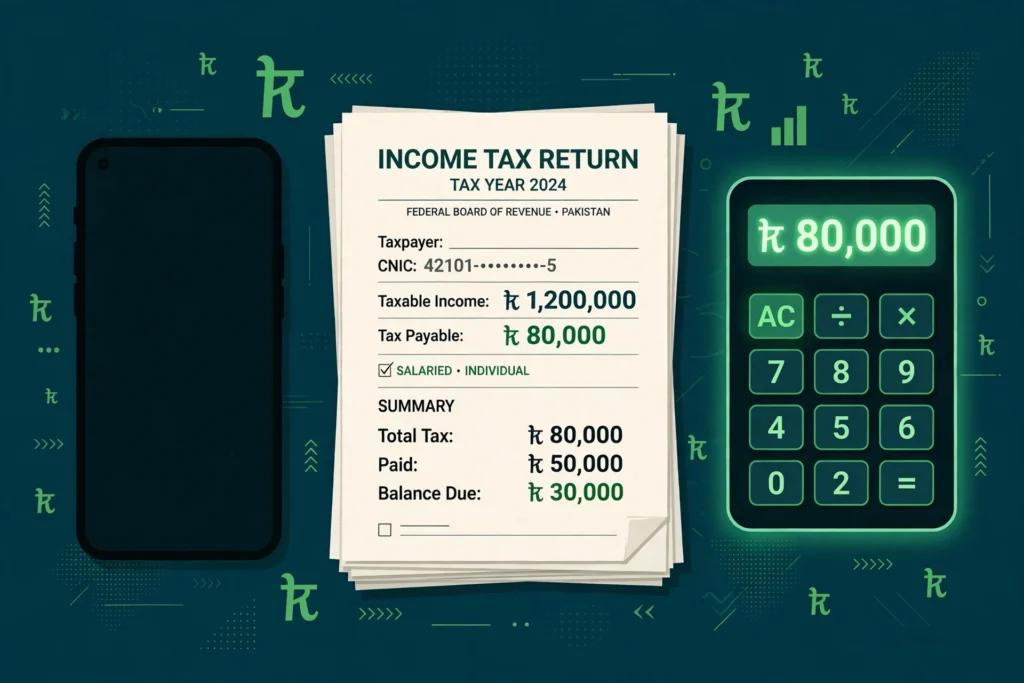
Ask any Pakistani who has brought a phone home from abroad and you will hear the same question: PTA tax kitna lagega? The answer confuses almost everyone, because the number on the DIRBS payment screen is not one tax at all. It is four separate charges, stacked on top of each other, and the total jumps in steps as the phone’s assessed dollar value crosses each threshold.
This MobZilo guide explains the complete PTA mobile tax rate table for fiscal year 2026–27 — the rates in force from 1 July 2026, verified against published rate tables from ProInfoDesk (last checked 8 October 2026) and Oraan’s explainer of the underlying laws. Every figure below comes from those official-rate tables; your final DIRBS amount may still differ slightly because FBR values each model individually and the exchange rate moves daily.
PTA Tax Is Not One Tax — It Is Four Charges
The biggest misconception about PTA tax is that it is a single fee. In reality, four different charges make up almost all of it, and each one is levied under a different law. As Oraan puts it: PTA itself does not charge you anything — it runs the DIRBS system that decides whether your handset works on a Pakistani network. The money is FBR’s, set by the Finance Act and the SROs issued each June.
Here are the four components, per Oraan’s breakdown:
- Regulatory duty — fixed rupee amount that steps up by value band (set by SRO 1064(I)/2026).
- Sales tax — the only true percentage: 18% on phones valued up to US$500, 25% above it (Ninth Schedule, Sales Tax Act 1990).
- Advance income tax — fixed rupee amount (Section 148, Income Tax Ordinance 2001), charged only on the CNIC route, up to PKR 11,500 for filers.
- Mobile handset levy — fixed rupee amount (Section 10, Finance Act 2018), up to PKR 16,000.
Only the sales tax is a percentage of the phone’s assessed value. Everything else is a fixed amount that jumps at each value threshold — which is why the tax on a phone just over a band boundary can be sharply higher than on one just under it.
The Complete Rate Table for FY2026–27
The table below shows every component for each customs-value band. The income-tax column shows the filer amount; non-filers pay double (PKR 200 / 200 / 200 / 1,940 / 10,000 / 23,000 respectively). The sales tax is calculated on the FBR-assessed value converted to rupees at the customs exchange rate.
| Customs value | Regulatory duty | Sales tax | Income tax (filer) | Handset levy |
|---|---|---|---|---|
| Up to US$30 | PKR 240 | 18% | PKR 100 | PKR 100 |
| US$31–100 | PKR 2,400 | 18% | PKR 100 | PKR 200 |
| US$101–200 | PKR 6,000 | 18% | PKR 100 | PKR 200 |
| US$201–350 | PKR 8,800 | 18% | PKR 970 | PKR 1,800 |
| US$351–500 | PKR 12,000 | 18% | PKR 5,000 | PKR 4,000 |
| US$501–700 | PKR 17,600 | 25% | PKR 11,500 | PKR 8,000 |
| Above US$700 | PKR 17,600 | 25% | PKR 11,500 | PKR 16,000 |
A worked example helps. Take a phone FBR values at US$150, registered on a CNIC as a filer. The fixed components are PKR 6,000 (regulatory duty) + PKR 200 (levy) + PKR 100 (income tax) = PKR 6,300. Add 18% sales tax on the assessed value — at an illustrative rate of PKR 280 to the dollar, that is 18% of PKR 42,000 = PKR 7,560 — for a total of roughly PKR 13,860.
Passport vs CNIC: Why One Route Is Cheaper
The table above applies to both routes, but there is one crucial difference: the advance income tax is charged only on the CNIC route. Registering on a passport means you skip that component entirely.
In practice that makes the passport route cheaper by the income-tax amount — PKR 100 on the cheapest phones, but PKR 11,500 (filer) on flagship phones above US$500. So if you bring in a phone valued at US$800 and register it as a filer, the fixed components are PKR 17,600 + PKR 16,000 + PKR 11,500 = PKR 45,100 on CNIC, versus PKR 33,600 on a passport. Add 25% sales tax on top of either (about PKR 56,000 at the illustrative exchange rate) and the gap stays at that PKR 11,500.
A few things to know about the passport route: it is meant for passengers registering within 60 days of arrival in Pakistan, and the old duty-free concession for travellers was withdrawn back in July 2019 — every phone now pays. Overseas Pakistanis do get one phone tax-free per visit for 120 days of use, according to widely reported rules.
The US$500 Line: Where the Tax Jumps
The most expensive threshold in the whole table is US$500. Above it, three things happen at once: sales tax jumps from 18% to 25%, the handset levy jumps from PKR 4,000 to PKR 8,000, and the regulatory duty jumps from PKR 12,000 to PKR 17,600. ProInfoDesk’s analysis puts it bluntly: a phone valued at US$505 pays almost PKR 20,000 more than one valued at US$500.
Two more facts that shape the final bill. First, in September 2026 the government cut the regulatory duty on imported smartphones by 20% — for example from PKR 22,000 to PKR 17,600 on phones above US$500 — so amounts are slightly lower than what last year’s tables show. Second, FBR assigns values to specific models through valuation rulings (such as Valuation Ruling 1999/2025), and in 2026 it reportedly revised valuations for 62 used models, lowering their tax. That is why the same model can show different DIRBS amounts at different times, and why brand-new phones with no ruling yet are valued on the standard slabs.
How to Check and Pay Your Exact Amount
Whatever the tables say, the final word is what DIRBS shows for your phone’s IMEI. Find your IMEI by dialling *#06#, then check it at dirbs.pta.gov.pk or by SMS to 8484 before you pay anything. Payment goes through 1Bill, JazzCash, Easypaisa or HBL Konnect, and the device is usually activated within 24 to 72 hours.
If the number shocks you, one new option exists: under FBR Circular No. 1 of 2026 (issued 11 September 2026), the sales-tax portion can now be paid in instalments through DIRBS instead of as one upfront payment — though the full amount must still be cleared within the same financial year. And remember the golden rule: because FBR’s assessed value and the exchange rate decide everything, treat every online figure — including the table above — as a guide, and the DIRBS amount as the bill.