Phone Display Types Explained: AMOLED vs LCD in Pakistan

Every phone you buy in Pakistan in 2026 has one of two kinds of screen — LCD or OLED — and the difference decides how your photos look, how readable the phone is in Lahore’s summer sun, and how smooth it feels when you scroll. The short answer: AMOLED is the best display for most buyers, an LTPO AMOLED is the best screen you can buy on a flagship, and a good IPS LCD is still the sensible choice under PKR 50,000. This guide explains AMOLED vs OLED vs LCD in plain language, what refresh rate and brightness numbers actually mean, and which display phones are worth your money in Pakistan right now.
All Pakistan prices below are reported prices checked on 9 November 2026, not official MRPs unless stated. Prices move with the dollar and dealer stock, so confirm the figure at the shop before you pay — and the team at MobZilo updates these guides as prices change.
LCD, OLED and AMOLED — how each screen actually works
An LCD (Liquid Crystal Display) does not make its own light. A white LED backlight sits behind the panel and shines through liquid crystals that twist to let more or less light through, with colour filters on top. Because the backlight is always on, even a black part of the image glows slightly grey in a dark room. The upside is real: LCDs are cheaper to make, they show clean natural whites, and they cannot suffer burn-in. IPS LCD — the good version of LCD, used in most budget phones — adds wide viewing angles and better colours than old TFT panels. Samsung’s PLS LCD, found on the Galaxy A07, is the same idea under Samsung’s own name.
OLED (Organic Light Emitting Diode) works the opposite way: every pixel produces its own light, and a pixel showing black simply switches off. That is why OLED blacks are truly black, contrast looks almost infinite, and dark scenes in videos have real depth instead of a grey wash. OLED panels are also thinner and lighter, which is why every foldable phone uses them, and they switch faster, so motion looks cleaner.
AMOLED is not a third technology competing with OLED — it is OLED, with an active-matrix layer of thin-film transistors behind the pixels that switches each one individually and precisely. That active matrix is what makes high refresh rates, always-on display and under-display fingerprint sensors possible. In practice, every OLED phone screen sold today is an AMOLED screen; when a spec sheet says OLED and another says AMOLED, they are describing the same panel family, and the marketing names on top — Samsung’s Super AMOLED and Dynamic AMOLED 2X, Apple’s Super Retina XDR — are tuning and branding, not different technologies.
LTPO is the newest refinement, and it matters more than most buyers realise. LTPO (Low-Temperature Polycrystalline Oxide) lets the screen change its refresh rate on the fly — dropping to 1Hz when you are reading a static page or showing the always-on clock, and jumping to 120Hz the moment you scroll or play a game. That is how flagships like the Galaxy S26 Ultra and Pixel 10 Pro XL get a 120Hz screen without the battery penalty a fixed 120Hz panel would carry. If a phone’s spec sheet says “1–120Hz adaptive”, it has an LTPO panel.
Refresh rate — 60Hz vs 90Hz vs 120Hz vs 144Hz
Refresh rate is how many times per second the screen redraws the image, measured in hertz (Hz). A 60Hz screen redraws 60 times a second; a 120Hz screen redraws twice as often. The difference is visible the moment you scroll Instagram, TikTok or a long WhatsApp chat: text stays readable while it moves on 120Hz, and turns into a blur on 60Hz. Gaming benefits even more, because a higher refresh rate means the screen can actually show the extra frames a fast chipset produces.
For most people, 120Hz is the sweet spot, and in 2026 it is no longer a premium feature. The Infinix Smart 20 — a budget phone with a reported price from PKR 39,999 — ships with a 120Hz IPS LCD, which shows how far the technology has spread. The Galaxy A07, at a reported PKR 47,999 on the official list, runs at 90Hz, which is noticeably smoother than 60Hz and fine for everyday use. The Tecno Camon 50 goes further with a 144Hz AMOLED panel, and some gaming phones now advertise 165Hz or even 185Hz — but beyond 120Hz the improvement is small, and only fast games can use it.
Two warnings before you shop by the number alone. First, a high refresh rate on a weak chipset stutters: the screen can only show frames the processor actually renders, so a 120Hz panel paired with a slow chip feels worse than a 90Hz panel on a fast one. Second, a fixed 120Hz panel drains the battery faster than a 60Hz one, which is exactly the problem LTPO solves — an LTPO screen idles at 1Hz and only spends battery on smoothness when you are actually moving something on screen.
Brightness in nits — why the 10,000-nit claim is misleading
Brightness is measured in nits, and it is the single most important display spec for Pakistan, where you use your phone in direct sunlight for half the year. But the number on the box is almost never the number you actually get, because brands quote three different figures and only advertise the biggest one.
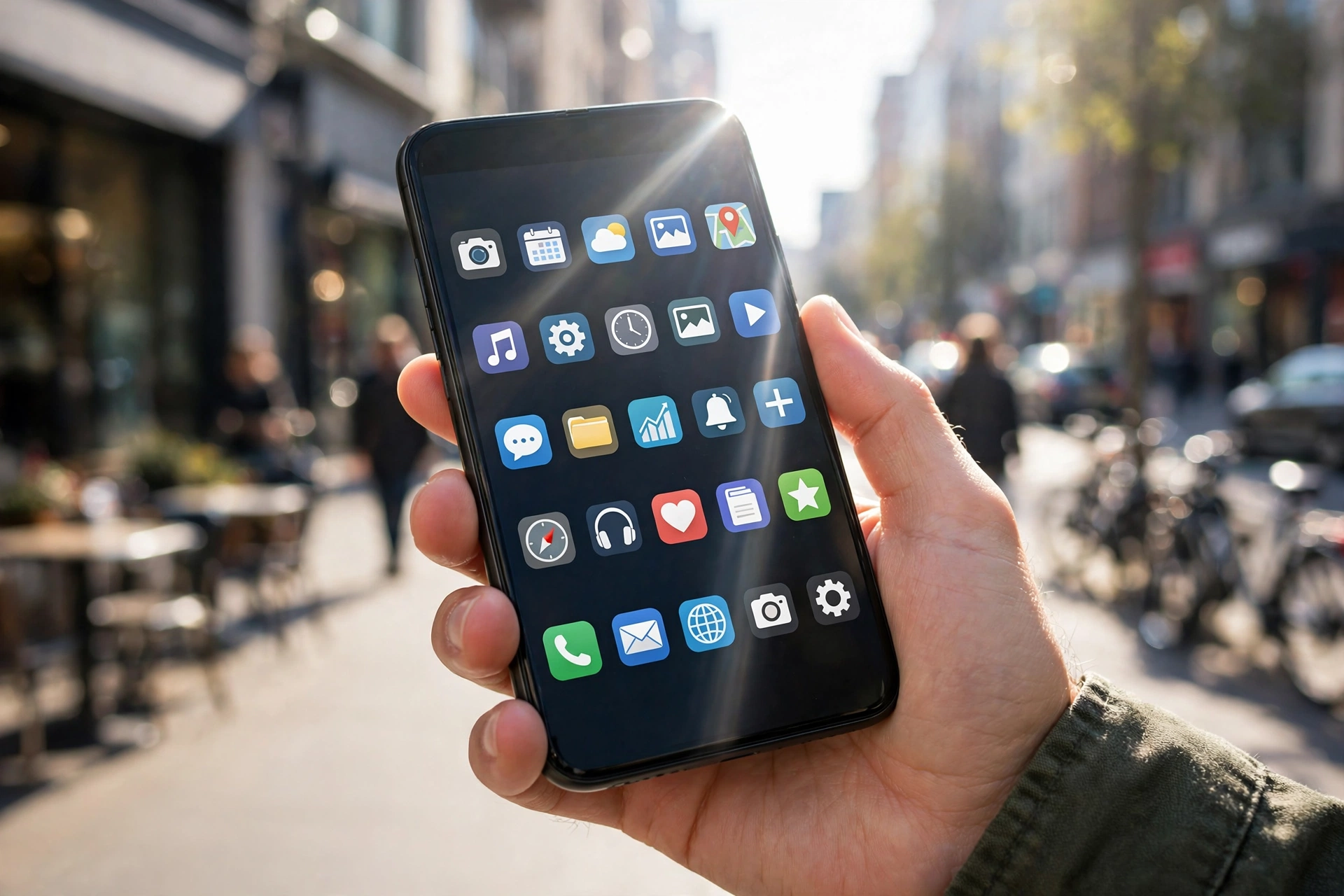
Peak brightness is the headline figure — the brightness of a small patch of the screen, for a few seconds, usually while showing HDR video. The Realme GT Neo6 SE was advertised at 6,000 nits peak, but its whole-screen brightness was 1,600 nits. Samsung’s new M16 panel, reported by GSMArena in September 2026, reaches 10,000 nits of local peak brightness — but its global peak, the brightness the whole screen can sustain, is 2,800 nits. High-brightness mode (HBM) is the honest number: the brightness the full screen holds in sunlight with auto-brightness on. Manual maximum is lower still, and it is what you get when you drag the slider yourself.
What should you actually look for? For comfortable outdoor use in Pakistan, aim for at least 1,000 nits HBM. The Galaxy A56 manages 1,200 nits HBM with a 1,900-nit peak, and it stays readable in harsh sun. The Infinix Smart 20’s 700 nits HBM is usable outdoors but washes out at noon. At the top end, PhoneArena’s 2026 display testing puts the Galaxy S26 Ultra at 2,600 nits peak, the iPhone 17 Pro Max at 3,000 nits peak and the Pixel 10 Pro XL at 3,300 nits peak — all of them effortless in sunlight, but all of them flagships costing over PKR 500,000. The practical lesson is simple: ignore the 6,000- or 10,000-nit headline, ask for the HBM figure, and test the phone in the shop doorway in daylight before paying.
Resolution, HDR and colour — what your eyes can actually see
Resolution is the number of pixels on the screen, and it matters most on a big phone held close. A 6.7-inch HD+ panel (720 x 1600, about 262 pixels per inch on the Galaxy A07) looks slightly soft if you hold it close and read small Urdu or English text; a Full HD+ panel (1080 x 2340, about 385 ppi on the Galaxy A56) looks sharp to almost everyone; a 1.5K panel (1208 x 2644, about 429 ppi on the Tecno Camon 50) is sharper still, but the difference over Full HD+ is small. Quad HD+ (1440p) on flagships is a luxury your eyes barely notice at normal viewing distance — it costs battery for almost no visible gain.
HDR is the feature that makes a real difference to video. HDR10+ and Dolby Vision let the screen show much brighter highlights and deeper shadows in the same frame, so a sunset in a YouTube video or a Netflix show actually looks like a sunset instead of a flat orange wash. HDR only works properly on OLED panels, because only OLED can turn individual pixels fully off for the dark parts of the scene — an LCD showing HDR is a compromise. Colour accuracy matters too: most phones now have a Vivid mode and a Natural mode, and the Natural mode is the honest one for photos. If you take a lot of photos, a good screen matters twice over — it is how you judge every shot you take, which is why our best camera phones under PKR 100,000 guide pairs camera quality with display quality rather than treating them separately.
Eye comfort — PWM flicker, blue light and burn-in
There is one real downside to OLED, and it affects a small but real group of people: flicker. OLED panels control brightness by switching pixels on and off very fast, a technique called PWM dimming. At low brightness, some panels flicker at only 240Hz, and sensitive users get eye strain or headaches after long reading sessions. This is not a myth — it is the reason brands now advertise their PWM frequency. The Tecno Camon 50 Ultra lists 2,160Hz PWM dimming, and Samsung’s M16 panel is reported at 3,300Hz PWM, both far above the threshold where most people notice anything. If screens give you headaches, look for a high PWM frequency, use the phone above 50% brightness, or choose an LCD phone — LCDs dim the backlight instead of flickering, so they do not have this problem at all.
Blue light is the other eye-comfort factor, and every modern phone has an eye-comfort or night mode that warms the screen colour after sunset. It helps you sleep better, and it costs nothing to turn on. Burn-in is the long-term OLED worry: because the pixels are organic, a static image left on screen for months — a status bar, a navigation bar, a game HUD — can leave a faint ghost behind. Modern phones fight it with pixel shifting, auto-hiding interface elements and automatic brightness, so it is rare before three or four years of heavy use. LCD screens are immune to burn-in entirely, which is one honest reason to pick an LCD phone if you keep your phones for five years or more.
Best display phones in Pakistan in November 2026
Here are the phones that give you the best screen for the money at each budget, with reported prices checked on 9 November 2026. Every price is a reported figure from retailers and aggregators — confirm it at the shop before you pay.
| Phone | Display | Refresh rate | Brightness | Reported price |
|---|---|---|---|---|
| Infinix Smart 20 | 6.78-inch IPS LCD, HD+ | 120Hz | 700 nits (HBM) | From PKR 39,999 |
| Samsung Galaxy A07 | 6.7-inch PLS LCD, HD+ | 90Hz | Not officially rated | From PKR 47,999 (official list) |
| Tecno Camon 50 | 6.78-inch AMOLED, 1.5K | 144Hz | HDR support | PKR 99,999 |
| Samsung Galaxy A56 | 6.7-inch Super AMOLED, FHD+ | 120Hz | 1,900 nits peak, 1,200 HBM | PKR 137,999 |
| Vivo V60 | 6.77-inch AMOLED, 120Hz | 120Hz | HDR10+ | PKR 149,999 (12GB/256GB) |
| Samsung Galaxy S26 Ultra | 6.9-inch Dynamic AMOLED 2X, QHD+ | 1–120Hz LTPO | 2,600 nits peak | PKR 524,999 (Samsung list) |
| iPhone 17 Pro Max | 6.9-inch OLED, ProMotion | 1–120Hz LTPO | 3,000 nits peak | PKR 565,000 (256GB) |
The value pick in this list is the Tecno Camon 50: a 144Hz 1.5K AMOLED at a reported PKR 99,999, which is a screen you would have paid flagship money for two years ago. It launched at PKR 74,999 in April 2026 and now sells at the higher reported figure, so check the current dealer price. The Galaxy A56 is the balanced pick — a bright, colour-accurate Super AMOLED with HDR10+ and 1,200 nits of sustained brightness at PKR 137,999. The Smart 20 proves the budget point: for PKR 39,999 you get a big, smooth 120Hz screen, and the only thing you give up against the AMOLED phones is deep blacks and outdoor brightness.
Which display should you buy?
Buy an AMOLED phone if you watch a lot of video, play games, read at night, or want the always-on display and under-display fingerprint sensor — the deeper blacks, better contrast and HDR support are worth it, and in 2026 you can get a good AMOLED panel from around PKR 99,999. Buy an LTPO AMOLED flagship only if you also want the best camera and the longest software support; the screen alone does not justify spending PKR 500,000. Buy an LCD phone if your budget is under PKR 50,000, if screens give you headaches, or if you keep a phone for five years and want zero burn-in risk — a good 120Hz IPS LCD like the Smart 20’s is genuinely pleasant to use, and the money you save buys a better camera or more storage.
Whatever you choose, test the screen before you pay: open a dark video in the shop, drag the brightness to maximum in daylight, scroll a long page fast, and look at the screen from a sharp angle. Those four checks tell you more than any spec sheet — and if you are buying second-hand, check the screen for burn-in and dead pixels first, using the steps in our original vs refurbished guide. A great display is the part of the phone you look at every minute you use it, so it deserves the same attention as the camera and the battery.
Frequently asked questions
Is AMOLED better than OLED?
They are the same panel family. AMOLED is OLED with an active-matrix backplane that enables high refresh rates and always-on display. Every OLED phone screen today is an AMOLED screen; the names on the box are branding.
Is LCD bad on a phone in 2026?
No. A good IPS or PLS LCD is sharp, accurate and flicker-free, and it cannot burn in. It loses to AMOLED on black levels, contrast, HDR video and outdoor brightness, but under PKR 50,000 it is the right trade-off.
Does a higher refresh rate drain the battery?
A fixed 120Hz or 144Hz panel does use more battery than 60Hz. LTPO panels avoid most of that penalty by dropping to 1Hz when the screen is still, which is why adaptive refresh rate matters more than the headline number.
How many nits do I need for sunlight in Pakistan?
Look for at least 1,000 nits of high-brightness mode (HBM) for comfortable outdoor use. Ignore the peak-brightness headline — it measures a small area of the screen for a few seconds, not the whole display in sunlight.
Can an AMOLED screen burn in?
Yes, over years of heavy use with static images on screen, though modern phones use pixel shifting and auto-brightness to slow it down. It is rare before three or four years, and LCD screens never burn in.